Long Island Abundant Life Church長島豐盛生命教會
  • Home
    • About Us 關於教會 >
      • Mission Statement - 使命宣言
      • Statement of Faith - 信仰立場
      • Biblical Marriage - 合乎聖經的婚姻
      • Church Leadership - 教會同工
      • Doc, membership - 文件, 會員
      • Contact Us - 聯絡我們
      • Directions - 路線圖
  • Chinese Ministry 華語事工
    • 崇拜
    • 講道集 >
      • 主日信息
      • 特會 / 講座
    • 主日學
    • 門訓小組 >
      • 門訓小組介紹
    • 團契
    • 讀經
  • English Ministry 英文事工
  • Youth 少年事工
    • Worship
    • Sunday School
    • Youth Fellowship
    • Events
    • Our Vision
    • Connect with Us
    • Parent Resources
    • Youth Prayer Requests
  • Children's Ministry 兒童事工
    • Children's Worship - 兒童崇拜 >
      • Children's Songs - 歌曲
      • Junior Worship, Archive - 學習內容
      • Junior Worship, Current - 學習內容
      • Preschool Worship, Archive - 幼兒崇拜
    • Sunday School - 主日學 >
      • Preschool - 低年級
      • Middlers, Current - 高年級
      • Elementary, Archive - 高年級
    • VBS-特别暑期聖經班 >
      • EVENTS- 特別活動
    • Nursery - 幼兒照顧
    • Resources - 資源
  • Missions/Evangelism 宣教/佈道
    • *Global Missions 全球宣教
    • *Missions Ministry 宣教事工
  • Chinese School 中文學校
  • Church Activities / News / Calendar 教會活動 / 消息 / 行事曆
    • 教牧心聲Pastoral & Coworkers' Sharing
    • 教會事工Church Ministry
    • Special/urgent 特別/緊急
    • Calendar 教會行事曆
    • Bulletin 週報
    • Archive 檔案 >
      • Pray for Hindus 2018 為印度人禱告
      • Seek God 2019 尋求神
      • Misc. 其他
  • Chinese Student Ministry 学生事工
    • Campus Ministry 校园事工
    • CSF 衣
    • CSF 食
    • CSF 住
    • CSF 行
  • Links 资源鏈接
  • 教會論

2 Corinthians 4:1–5:10

9/20/2012

 
Click here to read today's passage on Bible Gateway.

Too Much
Today's passage has too many good passages for me to cover everything as I'd like to - a bunch of my favorite passages in the Bible are here.  I'll just put a few of them out with some thoughts:

4:6 -
For God, who said, “Let light shine out of darkness,” has shone in our hearts to give the light of the knowledge of the glory of God in the face of Jesus Christ.

Do you want to see a miracle?  A lot of people seek miracles in the world today because they want to have some kind of "tangible" experience of God.  The verse makes it clear:  if you know Christ, you are a miracle.  The same powerful word that created - that said "Let there be light" and there was light - has spoken light into us.  If you know Jesus, it is the miracle of creation:  you are a new creation.  That is the greatest miracle.

4:7 -
But we have this treasure in jars of clay, to show that the surpassing power belongs to God and not to us.

God doesn't just zap us into perfect people when He speaks His light into us.  We remain imperfect, lest others look at us and say "I can never be like __________. He's got everything together and is an amazing person." We have the power of God, the light of God, in "jars of clay" - plain things that don't draw attention.  Things work this way because people then look us and see the power of God working, not the power of self-will and personal "drive".  That's the way it should be.  Let God have the power and glory, don't take it for yourself.

4:17 -
For this light momentary affliction is preparing for us an eternal weight of glory beyond all comparison...

This is one of the foundational ideas behind our current sermon series on suffering:  things may seem bad now, but they aren't even worth comparing to the good and glory that will come.  Our bodies are dying a little more and more each day, but our "inner self" is becoming more and more alive as we get closer and closer to glory.

5:4 -
For while we are still in this tent, we groan, being burdened—not that we would be unclothed, but that we would be further clothed, so that what is mortal may be swallowed up by life.

We in the US have a very unfortunate and untrue view as a culture of what heaven is like.  There we'll be:  ghosty things floating around in togas with harps.  This verse destroys that view.  We will not be unclothed (our bodies removed), but further clothed.  Our broken mortal bodies will be replaced by resurrection bodies.  This sad, decaying form will be swallowed up by TRUE life and a true body.  Who wouldn't be excited to wait for that?  It's way better than being a ghost in a toga.

Like I said, there's a lot here and I haven't really given a lot of context and flow of thought, but I HIGHLY recommend that you take a listen to this message from our passage today.  I don't put sermons on here very often, but this one is definitely worth it.  It's called "Hurting But Hopeful":
hurting_but_hopeful.mp3
File Size: 20008 kb
File Type: mp3
Download File

2 Corinthians 3

9/19/2012

 
Click here to read today's passage on Bible Gateway.

Life and Death, Old and New
I think the best thing I can do today is to summarize what Paul is saying in chapter 3 - it's a really vivid illustration at the heart of the relationship between the Law and the Gospel, and I want to make sure that we get it.

First, the beginning of the chapter and why Paul shifts the topic:

"Paul's argument now takes a decisive turn. Up to now, he has argued for the legitimacy of his ministry based on his suffering as the divinely ordained means for mediating the comfort of God to believers (1:3–11) and the knowledge of God to the world (2:14–17). Beginning in 3:1–3, Paul vies for the validity of his apostleship based on the presence and power of the Spirit as the specific content of his mediation. If the means of Paul’s apostolic ministry is his suffering, the Spirit is its content as the one who converts and comforts the Christian and convicts the world (1:21–22; 2:15–16a)." [1]

Paul speaks of letters of recommendation.  Most likely other "apostles" that people liked better would come into town with glowing recommendations from "famous" people about how good they were.  Paul says that the Corinthians themselves are his recommendation: they are the proof of his work, not written with ink but with the Holy Spirit, not written on tablets of stone (like the Law was) but on human hearts.  Paul then goes on to explore the difference of the Law and the Spirit, the Old and New Covenants.

The Law killed - led to condemnation because failure to follow it brought punishment.  Even so, after Moses received it, his face was so glorious that the people couldn't look upon it (see Exodus 34:29–35).  Paul reasons that if the ministry that brought death could be so glorious, how much more glorious the ministry of the Spirit is!  The ministry of the Law (the very commands of God) was glorious, but compared to the ministry of the Spirit (God Himself) it seems like it has almost no glory.  The age of the Law came to an end, but the endless age of the Spirit will be much more and permanent glory.  Moses put a veil over his face because the people couldn't understand and tolerate the glory they saw there.  Paul says that even then, followers of the Law still have that veil between them and the glory of God.  Only Jesus can remove the veil that hides the glory of God.  Only through Jesus can we behold and understand the glory of God free from the punishment and condemnation of the Law.  That is true freedom - knowing God truly.  And by beholding Him and knowing Him truly we are being transformed more and more into His image.  That is the ministry of the New Covenant, the ministry of the Spirit. 

This is a big topic that we'll continue to come back to - the difference between the Old and New.  Much of the NT is about this.  You might think that this isn't very applicable because we aren't Jews and weren't raised on the Law, but don't be fooled:  the condemnation of the Law falls on us all without Jesus, and it is the natural bent of the human heart to seek affirmation from standards.  Why else do we kill ourselves to be successful, make lots of money, and be respected.  These things are a mere symptom of the deception of our hearts the causes us to seek affirmation and escape condemnation through our own efforts and the opinions of others, all the while ignoring that we fall ridiculously short of the standard God has set.  There is certainly the main sense in which these passages speak of the Mosiac Law, but a also a broader sense in which it applies very deeply to everyone that seeks to get approval by any standard other than the grace of God. 

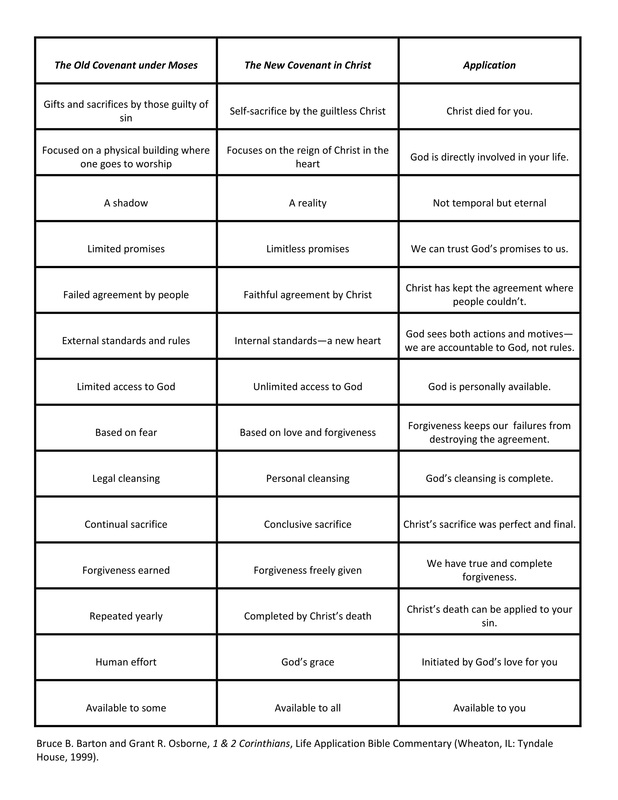
As a bonus, here's a great chart from the Life Application Bible Commentary comparing some major differences between the Old and New Covenants.  It's a great summary - make sure you take time to look through it and really reflect on what these things mean:
Old and New Covenants
(Click to enlarge)

[1] Scott J. Hafemann, 2 Corinthians, The NIV Application Commentary (Grand Rapids, MI: Zondervan Publishing House, 2000), 115.

2 Corinthians 2

9/18/2012

 
Click here to read today's passage on Bible Gateway.

Paul's and the Corinthians
In today's reading, Paul mentions a "painful visit" to the Corinthians.  Paul had a number of letters and visits exchanged with the Corinthians.  As we saw in 1 Corinthians, the relationship between them was difficult:  the church itself had a lot of problems, as well as a large group of people who didn't particularly like Paul.  This letter is called 2 Corinthians, but there was most likely another letter in between 1 and 2 Corinthians that God didn't think the Church needed to have in the NT canon.  We don't have this letter, but the context of 2 Corinthians suggests that there was more communication.  All this being said, it's difficult to construct a timeline of the relationship based on the material we have.  Here's a good try at it - many others would be very similar with some slight differences:
Paul and the Corinthians
(Click to enlarge)

Paul certainly cared about this church:  despite hatred from some and a vast array of problems, Paul spent a lot of time working, writing, and visiting this church. 

One more quick note about 5-11 to give some understanding:

"Though Paul nowhere mentions the specifics of the offense itself, it must have involved some sort of slander against him and his apostolic relationship with the Corinthians. Perhaps the offender had been a person of influence who had sided with Paul’s opponents and led the opposition against Paul. Whatever the case, most of the Corinthians had initially sided with this slanderer. Later, after the majority had repented as a result of his “tearful letter” (2:4; 7:8–13), they grieved with Paul because of the offender’s influence over them. They consequently punished the offender (2:6), most likely by excluding him from the fellowship of the Christian community in accordance with the precedent set in 1 Corinthians 5:2, 5, 13.
    The punishment had its intended, salutary impact. The offender had repented. He was ready to rejoin the congregation. In response, Paul calls the Corinthians to follow in his footsteps not only in pouring out punishment on those who deserve it, but also in showing mercy to the repentant." [1] (emphasis mine)

This is the second part of church discipline.  I mentioned in 1 Corinthians that most churches have a real problem in enacting church discipline.  First of all, most churches simply are willing to do it.  But the second problem that churches have is this one:  they are willing to "punish", but not to forgive.  Remember, the purpose of church discipline isn't punishment, but restoration.  As faithfully as the discipline is enacted, the restoration and forgiveness should be enacted.

Questions? Comments?

[1] Scott J. Hafemann, 2 Corinthians, The NIV Application Commentary (Grand Rapids, MI: Zondervan Publishing House, 2000), 88.

2 Corinthians 1

9/17/2012

 
Click here to read today's passage on Bible Gateway.

Introduction to 2 Corinthians
As usual, we're going to be combining the first few days of posts with some introductory material about the book.  There will be more introduction this time because of the close relationship between 1 and 2 Corinthians and some other issues/questions about how 1 and 2 Corinthians fit together with other possible writings/visits.  Let's just start with some helpful information for understanding the letter in a broad sense:

    "A.      II Corinthians was written about six to eighteen months after I Corinthians, following Paul’s visit in Macedonia with Titus, who reported the church’s response to Paul’s overtures (cf. 2:12–12; 7:11–16).
    B.      This is a very intense personal letter. Paul’s emotional state can even be observed in the grammar (lack of conjunctions and incomplete sentences).
    C.      Paul was being viciously attacked by a minority within the church. The minority seems to be both from the local Corinthian congregation and an itinerant Jewish group. Their charges were:
      1.      Paul had impure motives, 1:12
      2.      Paul was fickle, 1:15ff
      3.      Paul was weak, 10:10
      4.      Paul was physically ugly, 10:10
      5.      Paul was not a good orator, 10:10; 11:16
      6.      Paul preached for money 11:7ff; 12:13ff
      7.      Paul was not a true apostle, 11:5, 13; 12:4
      8.      Paul was not an orthodox Jew, 11:21ff
      9.      they had direct revelation, but Paul did not, 12:1ff.
" [1]

This is an intense letter.  But notice how Paul starts - look at the repeated words:  affliction and comfort.  Take some time to read the beginning slowly and understand how affliction, comfort, God, us, and others all relate to each other, because it's a very important and very applicable concept. 

Why do you think Paul starts such an emotional and painful letter this way? I'd love to hear your thoughts.

[1] Robert James Utley, vol. Volume 6, Paul’s Letters to a Troubled Church: I and II Corinthians, Study Guide Commentary Series (Marshall, TX: Bible Lessons International, 2002), 200.

1 Corinthians 16

9/16/2012

 
Click here to read today's passage on Bible Gateway.

His Own Hand
Just a quick, interesting note on the closing of the letter.  We'll see Paul make similar statements later on, I want to give you some insight into the ending of the letter:

"After verse 20, Paul stops dictating his letter to his amanuensis (the “secretary” writing down the letter)—was it Sosthenes (1:1)? Paul now picks up pen and papyrus himself to write the closing words in his own hand (v. 21), as was his custom (cf. Gal. 6:11; 2 Thess. 3:17; other ancient letter writers often did the same). The one letter in which we definitely know the name of Paul’s amanuensis is Romans, when that individual, Tertius, sent his own greetings at the end (Rom. 16:22)."
[1]

See also:
"Usually Paul would dictate his letters to a scribe, and often he would end with a short note in his own handwriting (see also Galatians 6:11; Colossians 4:18; 2 Thessalonians 3:17; Philemon 1:19). This is similar to adding a handwritten postscript (P.S.) to a typewritten letter. This greeting with [Paul’s] own hand assured the recipients that false teachers were not writing letters in Paul’s name (as apparently had been a problem—see 2 Thessalonians 2:2; 3:17). It also gave the letters a personal touch." [2]

[1] Craig Blomberg, 1 Corinthians, The NIV Application Commentary (Grand Rapids, MI: Zondervan Publishing House, 1994), 339.
[2] Bruce B. Barton and Grant R. Osborne, 1 & 2 Corinthians, Life Application Bible Commentary (Wheaton, IL: Tyndale House, 1999), 251.

1 Corinthians 15:35–58

9/16/2012

 
Click here to read today's passage on Bible Gateway.

My apologies that this post is one day late.  Yesterday I had to deal with some personal issues and was unable to post.  Better late than never!

Fearless
"The ultimate vanquishing of death, with which 1 Corinthians 15 culminates, surely speaks volumes to those who continue to live in fear of death today...Christians ought to fear less. They may grieve the loss of loved ones and have a certain anxiety related to the unknown factors surrounding their own death, but neither reaction ought to be “like the rest of men who have no hope” (1 Thess. 4:13). Funerals for Christians ought to be first of all celebrations of their “homegoing.” While preserving a culturally appropriate solemnity, a spirit of joy and a message of hope should nevertheless pervade such ceremonies, which may even include a tasteful evangelistic address to unbelievers present. And the hope of resurrection should encourage those of us who remain alive to persevere in a “long obedience in the same direction” (v. 58)." [1]

[1] Craig Blomberg, 1 Corinthians, The NIV Application Commentary (Grand Rapids, MI: Zondervan Publishing House, 1994), 322.

1 Corinthians 15:12–34

9/14/2012

 
Click here to read today's passage on Bible Gateway.

Don't Ever Forget the Resurrection
As I mentioned a few days ago in the post about communion, I think that the Church (at least in a lot of the US) is sadly lacking it its focus on the resurrection.  We talk a lot about the crucifixion, we have crosses everywhere, and talk a lot about the sacrifice of Jesus.  The problem is that we rarely talk about the VICTORY of Jesus.  You can't think about the cross without thinking about the empty grave.  That is one of the reasons why I think our communion services are sorely lacking.  Paul writes in our passage today about this very topic.  Evidently there were some in Corinth who were denying the resurrection of Jesus and/or of believers at Jesus' return.  Paul spends today's reading correcting that view.  Why is the resurrection so important?  Read:

"The resurrection brings us to the very center of the Christian faith. When Paul was on trial for his life before the Jewish leaders, he summed up the charge against him as his “hope in the resurrection of the dead” (Acts 23:6; cf. 24:21; 26:6–8). When he clothed the gospel for the Athenians in almost entirely different garb, he nevertheless still focused on “Jesus and the resurrection” (Acts 17:18). His emphasis on the resurrection in 1 Corinthians 15 in no way contradicts 2:2—Christ’s death and resurrection are inseparable. Without the latter, the former has no eternal significance. To counteract those who play down the weakness and servanthood of Jesus, Paul must stress the crucifixion, but to refute those who deny a future material hope for believers and the cosmos, he must stress Jesus’ bodily resurrection." [1]

The resurrection not only is the center of our belief in Jesus, but it is what sets us apart from believers in other religions:

"Christ’s death and resurrection in space and time, as bona fide historical events, actually set Christianity apart from all its major rivals. Later Western religions that developed in part in reaction to Christianity do not claim deity or resurrections for their originators, merely prophetic status (e.g., Mohammed in Islam or Joseph Smith in Mormonism). Older Eastern religions do not even require the actual historical existence of their founders for their beliefs and practices to make sense. In some ways they are more akin to philosophies than to historical truth-claims (e.g., Hinduism, Buddhism, Confucianism). But Christianity lives or dies with the claim of Christ’s resurrection. To be sure, it is possible to believe in Jesus’ resurrection and not become a Christian, but without the bodily resurrection Christianity crumbles. Finding the bones of Jesus would assuredly disprove our religion!"
[2]

Paul is clear.  If there is no resurrection, we're wasting our time with Christianity.  Christianity isn't convenient - it demands a lot of things people are unwilling to give.  The reasons we do give up our very selves is that it also has the foundation of being TRUE.  If it were just a belief system, Paul says, "Abandon it."  But it's more than that - it's a risen Savior, a Person.

"Why does Paul say believers should be pitied if there were only earthly value to Christianity? In Paul’s day, Christianity often brought a person persecution, ostracism from family, and, in many cases, poverty. There were few tangible benefits from being a Christian in that society. It was certainly not a step up the social or career ladder. Even more important, however, is the fact that if Christ had not been resurrected from death, Christians could not be forgiven for their sins and would have no hope of eternal life.
    In many places in the world today, those who believe in Christ still pay a heavy price. Some are dying for their faith. But for many, Christianity is little more than a convenient faith. If following Christ doesn’t place you at odds with the world around you in some way, examine the depth of your roots."
[3] (emphasis mine)

Being at odds with the world in which you live isn't pleasant.  But that's the point:  you don't belong here, so you shouldn't feel like you do.  Christianity isn't a religion that will gain you points with many people, but that's not the point.  The point is the resurrection - the point in history in which everything changed.  The point at which you were changed:  made a new creation.  Don't ever forget that.

[1] Craig Blomberg, 1 Corinthians, The NIV Application Commentary (Grand Rapids, MI: Zondervan Publishing House, 1994), 300.
[2] Ibid, 308.
[3] Bruce B. Barton and Grant R. Osborne, 1 & 2 Corinthians, Life Application Bible Commentary (Wheaton, IL: Tyndale House, 1999), 226.

1 Corinthians 15:1–11

9/13/2012

 
Click here to read today's passage on Bible Gateway.

A Short and Important Passage
Today's reading is relatively shorter than a lot of them we've had lately, but is a very important passage for a number of reasons.  I'm just going to deal briefly with the foundational one:  it is a very clear and concise telling of the Gospel.  Paul is either reiterating or summarizing what he taught the Corinthians, which he received himself.  Here's what he has to say, separated out:

1. Jesus died
2. He died for our sins
3. The Scriptures predicted this
4. He was buried
5. He rose again (this will be important later on in chapter 15)
6. This is also in accordance with the Scriptures
7. He appeared to Peter
8. He appeared to the rest of 12
9. He appeared to a large group of 500
10. Most of those witnesses are still alive (at the time of writing)
11. He appeared to James
12. He appeared to the rest of the apostles
13. He appeared to Paul

That's being ridiculously meticulous in splitting it up, but the main idea is this:  "Jesus died for our sins and rose again according the the Scriptures.  The OT testifies to this. As proof, He then appeared to many people, most of whom are still alive, so go ask them!  And also to me."  This is a really, really concise telling of the Gospel and a mostly likely a summary of Paul's teaching in Corinth.  We're going to see that the main force of what he's saying is on the resurrection:  miss that and you miss everything.

If you were going to divide the Gospel into several points for sharing, how many would you have and what would they be?  Paul has about 4 or 5 main thoughts about the content of the Gospel (as presented here, depending on how you divide them).  What do you think is necessary?  I think I would probably divide it out something like this:

1. God is creator and King
2. We are sinful and bear the penalty of rebellion
3. Jesus is God
4. He died for our sin and penalty
5. He rose again proving He was God and giving us His righteousness
6. Believe who He is and turn from rebellion to get His free gift of grace

That's a little wordy and you could probably combine some of them, but I think that covers all the major necessary points.  What about you?  Would you present it differently?  How?

1 Corinthians 14

9/12/2012

 
Click here to read today's passage on Bible Gateway.

Excitement and Truth in Church
Today we deal with a passage that deals almost exclusively with "charismatic" (tongues, healing, prophecy) gifts.  This is a very big and complicated issue - this isn't the venue to deal with an issue so big or divisive, but suffice to say that some people believe that these gifts are still operating today and some believe that they are not.  Working from that framework, Blomberg has some good and important thoughts about the application of this passage today:

    "Christians sometimes struggle to find relevant passages of Scripture that speak directly and in detail to contemporary problems. Such is the case, for example, with abortion, ecology, and nuclear war. In chapter 14, however, we find remarkably clear and detailed teaching that bears directly on one of the most divisive issues in the church today—the debate over the so-called charismatic or more supernatural gifts.
    The charismatic movement is known for emphasizing the value of speaking in tongues. To many in that movement, Paul would surely say today that greater emphasis is needed on the more immediately intelligible and more cognitive gifts. Many sermons in charismatic or Pentecostal circles lack consistent, clear exposition of texts of Scripture. The recent neo-prophetic movement has heralded something of a shift away from tongues to prophecy. But it tends to conceive of the latter in a very narrow, highly supernatural sense and often does not submit its revelations from the Lord to the evaluation of a congregation and a duly recognized group of church leaders. Decision-making in the charismatic world often seems highly subjective, as people explain their actions with little more than the rationale, “The Lord told me to do such-and-such.” But how do they know for sure what they heard was from the Lord or, if it was, that they interpreted it entirely correctly? Authoritarian leaders within this movement can at times rule ruthlessly and without fear of contradiction because those under them believe everything spoken “in the name of the Lord.” It would probably be good if no Christian today ever said, “The Lord told me …” lest God get blamed for human error, but rather preface their remarks with, “I believe the Lord has told me …”
    Noncharismatic churches too are increasingly moving away from solid instructional messages based on biblical content. Many favor a more entertainment-oriented style of worship, and “seeker-sensitive” messages, often with the worthy motive of attracting the unbeliever or church-hopper who judges local congregations on the value of many services they provide other than preaching. Such churches recognize the need to avoid Christian “jargon,” in-house or theological language that outsiders find strange and difficult to comprehend. But if large-group worship services take this form, then it becomes crucial that the church stress that its members become involved in additional activities that provide detailed instruction in the Bible, Christian doctrine, ethics, and the like. These can take the form of Sunday School, special seminars, or small groups.
    The value in both charismatic and noncharismatic circles of a clear proclamation of God’s Word over and above more unusual phenomena like tongues remains indisputable. In Paul’s world, at least the more exotic phenomena reminded people of analogous practices in other religions, so that they were not entirely foreign. In our modern day, many unbelievers seeing glossolalia for the first time will be all the more convinced that Christians are “out of their mind” (v. 23). Indeed, the excesses of the charismatic movement, especially through televangelism, are one of the major reasons all conservative Christianity has been caricatured, stereotyped, and rejected as weird and out-of-touch with reality by many contemporary Westerners, especially in the media." [1] (emphasis mine)

The message is this:  if you think charismatic gifts exist, use them the right way as specified in this passage.  If you don't, beware of other "flashy" forms of "church" that focus on entertainment and excitement rather than truth and worship.  This is an insanely needed message for much of the church today.

Questions?  Comments?

[1] Craig Blomberg, 1 Corinthians, The NIV Application Commentary (Grand Rapids, MI: Zondervan Publishing House, 1994), 275-76.

1 Corinthians 13

9/11/2012

 
Click here to read today's passage on Bible Gateway.

True Love
1 Corinthians 13 is probably the most well-known extended passage of the Bible.  It has been read at countless weddings and other events, and for good reason:  it is an amazing exposition of what love is.  Amidst all the weddings and Christian love letters and everything else, we still need to remember that Paul wrote this for a reason, and it exists within a letter, not simply on its own:

"The key to understanding chapter 13, then, is to keep it in its context. Whatever inspiration it may have as a self-contained poem or hymn to love, Paul intended it to be used to help solve the specific problem of the destructive manner in which the Corinthians were using their spiritual gifts...
    ...If it is more excellent than even the greater gifts, then love itself cannot be a spiritual gift. Rather it represents the cardinal Christian virtue, the first on the list of the “fruit” of the Spirit (Gal. 5:22), which must be present with all the gifts if they are to be used in ways that will please God and have eternal value." [1]

This passage certainly has meaning and significance in the broader context of the Christian life, but its main purpose pertains to understanding and correctly practicing spiritual gifts.  We need to remember that in order correctly follow the line of thinking in this letter.  That being said, I'm going to spend the rest of the post talking about the meaning and implications of the "Love Chapter" in the broader sense of the whole Christian life.

One of the important things to remember when reading this passage is the main word:  love.  The problem is that while our culture has only one primary word with a number of different meanings, the NT has three main words it uses for "love": agape (Christian love for others), phileo (the type of love between a brother or friend), and eros (physical/romantic love).  The word used in this passage is the first one.  Why is this important?  We must remember that this passage is speaking in terms of "agape" love, while our society defines love almost solely in the sense of "eros" love.  I would argue that this passage isn't seeking to show us how to have a good relationship with a boyfriend/girlfriend.  It's simply not even using that word.  Our society has conditioned us to think of love mostly or only in that sense, whereas this passage is talking about a foundational kind of love for all that one builds the Christian life upon.  What is THAT kind of love like? 

"It has often been observed that one could substitute the word “Jesus” for “love” throughout verses 4–7. Indeed, as the only sinless person in human history, he provides the perfect model for helping us to understand what patience, kindness, lack of envy, and so on, are. In so doing, we also guard against misinterpreting these attributes. If Jesus was all-loving, but could clear the temple in righteous indignation (Mark 11:15–18) or unleash a torrential invective against the hypocrisy of the conservative religious leaders of his day (Matt. 23), then our concept of love must leave room for similar actions...
    ...Yet one of our greatest problems is defining love. Popular culture—in literature, music, advertising, and the visual arts—uses the word to mean just about everything except what the Bible means by it. So even Christians are easily misled into thinking love is primarily a feeling, something you fall in or out of. We equate it with lust or sexual intercourse itself, speaking of one’s “lover” (unless one is properly married, when the term actually would be appropriate) or of “making love.” But in this chapter, as throughout Scripture, love is first of all an action, an unconditional commitment, a promise that is never broken." [2] (emphasis mine)

That's a VERY important distinction to make:  love is not primarily a feeling, but an action.  This is the basis of the Biblical understanding of this love.  You cannot building a life upon feelings, but you can build it upon action and commitment.  Again, our culture teaches something different:

"Society confuses love and lust. Often, so do believers. Unlike lust, God’s kind of love is directed outward toward others, not inward toward one’s self. It is utterly unselfish. This kind of love goes against natural inclinations. It is possible to practice this love only if God helps us set aside our own desires and instincts so that we can give love while expecting nothing in return. Thus the more we become like Christ, the more love we will show to others." [3]

Lastly, some important thoughts about the closing remarks about faith, hope, and love:

"Faith is the foundation and content of God’s message; hope is the attitude and focus; love is the action. Faith informs action; hope influences action; love is action. When faith and hope are in line, you are free to love completely because you understand how God loves. Does your faith fully express itself in loving others?" [4]

Love doesn't just demand action, love IS action.  If you're at all unclear about that, spend some time reading 1 John.  Are you loving others, or simply trying to produce feelings?

[1] Craig Blomberg, 1 Corinthians, The NIV Application Commentary (Grand Rapids, MI: Zondervan Publishing House, 1994), 261.
[2] Ibid, 262, 264.
[3] Bruce B. Barton and Grant R. Osborne, 1 & 2 Corinthians, Life Application Bible Commentary (Wheaton, IL: Tyndale House, 1999), 188.
[4] Ibid, 194.
<<Previous
Forward>>

    RSS Feed

    Archives

    December 2012
    November 2012
    October 2012
    September 2012
    August 2012
    July 2012
    June 2012
    May 2012
    April 2012
    March 2012

Powered by Create your own unique website with customizable templates.